
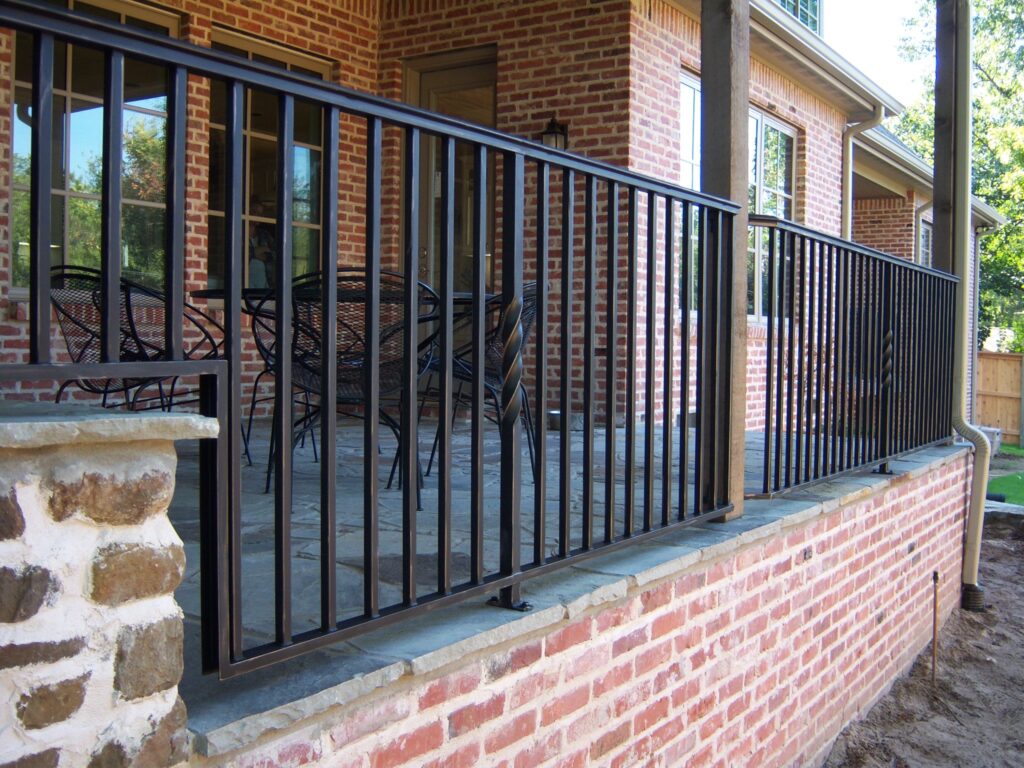
Decorative Iron Fence Panels: Custom Looks Without a Full Fence
I get this call a lot: someone loves the look of an iron fence, but they don’t need one running the whole property line. Maybe they’ve got a stone entry wall with an open gap on top, or a pair of brick columns at the driveway that just need something between them, or a plain wood fence that could use one section dressed up. That’s exactly what decorative iron fence panels are for, and it’s one of my favorite kinds of project because it lets us do something custom without the scope (or the cost) of a full fence build.
I’ve been building ironwork by hand in Broken Arrow since 1998, and panels like these have become one of the most requested projects we do for homeowners around Tulsa. Here’s what I’d want you to know before you start shopping around.
What Are Decorative Iron Fence Panels, Really?
A decorative iron fence panel is a standalone section of ironwork, built to fill a specific space rather than to enclose an entire yard. Instead of running posts and pickets from corner to corner, we’re building one piece (or a few) that drops into an existing gap, tops off a wall, or accents a spot that’s otherwise plain.
That’s different from what most people picture when they hear “iron fence.” A full fence is a perimeter. A panel is a detail. Homeowners bring us panels when they want the character of ironwork in one or two specific spots, not the whole job.
Where Decorative Iron Fence Panels Make the Most Sense
In my experience, a few situations come up again and again:
A gap on top of a low stone or brick wall. Tulsa has a lot of homes with masonry knee walls out front, and an open gap on top just invites people (and dogs) to hop right over. A panel closes that gap and finishes the wall off properly.
Between entry columns. If you’ve got stacked-stone or brick columns flanking your driveway or front walk, an iron panel between them ties the whole entry together without you having to fence the entire yard.
Flanking a gate. A lot of our walk-gate clients want a short run of matching panel on either side, just enough to frame the gate and keep it from looking like it’s floating in the middle of nowhere.
Dressing up an existing fence. Sometimes a client has a wood or chain-link fence they’re not ready to replace, but they want one section, usually near the front, to look better. A custom panel there does a lot of work for not a lot of money.
If you want a sense of what these can look like once they’re built and installed, I keep a gallery of completed iron fence and panel projects that’s worth a look before you settle on a design.
Custom Iron Fence Panels vs. Off-the-Shelf Panels
This is where I try to save people some frustration. If you search “decorative iron fence panels” online, most of what comes up is stamped steel panels sold in fixed sizes, meant to be staked into the ground for garden borders or small accent areas. Nothing wrong with those for what they’re built for, but they’re not made to match your masonry, your ground slope, or your existing ironwork.
I’ve had customers order a panel like that, get it home, and realize it’s four inches short of the gap or the wrong shade of black next to their existing rail. A hand-built panel is measured to your exact opening, welded to sit flush against your columns or wall, and finished to match anything else on the property. It costs more than a box-store panel. It also fits the first time.
If you’re weighing iron against other fencing materials for the rest of your property, Bob Vila’s rundown of common fencing materials is a fair, no-nonsense place to start comparing options before you commit.
Design Options for Decorative Iron Fence Panels
Once we know where the panel is going, the fun part is the design. Classic vertical pickets with spear tops still get requested more than anything else, especially on older Tulsa homes where that look matches the era of the house. Scrollwork panels, with curls and flourishes worked into the iron, tend to go on newer builds where the owner wants something that feels more custom and less “off the rack.”
We’ve also done panels with cut-out motifs, initials, state outlines, oak leaves, that sort of thing, worked right into the design. Ornamental ironwork has always been a place where a homeowner could put a personal stamp on their property; it’s a tradition that goes back centuries, and the National Park Service’s preservation guidance on architectural cast and wrought iron is a good read if you’re curious how much design variety this material has carried through different periods of American architecture.
Building and Installing Custom Iron Fence Panels
Every panel starts with a site visit. I need the actual measurements of your gap, wall, or opening, because “close enough” doesn’t work when you’re welding metal to fit a specific space. From there we sketch the design, get your sign-off, and build the panel by hand in our Broken Arrow shop.
Once it’s fabricated, every panel gets powder coated before it leaves us. That finish matters more here than people expect. Oklahoma swings between ice storms and 100-degree summers, and a cheap paint job will chip and rust within a couple of seasons. Powder coating bonds to the metal instead of just sitting on top of it, so it holds up to that swing a lot better.
Installation is its own step, especially when we’re anchoring a panel into existing masonry or matching it to ground that isn’t perfectly level. If you’re ready to talk through what a panel would take for your specific setup, reach out and we’ll get you a free quote.
Do Decorative Iron Fence Panels Add Value to Your Property?
I won’t tell you a single panel is going to swing an appraisal, but exterior details are consistently where homeowners see the best return on their money. The National Association of Realtors’ most recent Remodeling Impact Report backs that up year after year: buyers form an opinion of a home before they ever walk through the front door, and small, well-done exterior upgrades tend to punch above their cost. A decorative iron panel in the right spot, an entry wall, a gate, a plain stretch of fence, is exactly the kind of detail that changes how a house reads from the street.
If you’ve got a spot on your property that’s been bothering you, a gap that never got finished, a wall that needs a topper, a gate that needs framing, that’s a conversation worth having. I’ve spent close to three decades building ironwork for this area, and I still like the panel projects best, because every one of them is a little different.
Author: Darin Berryhill