
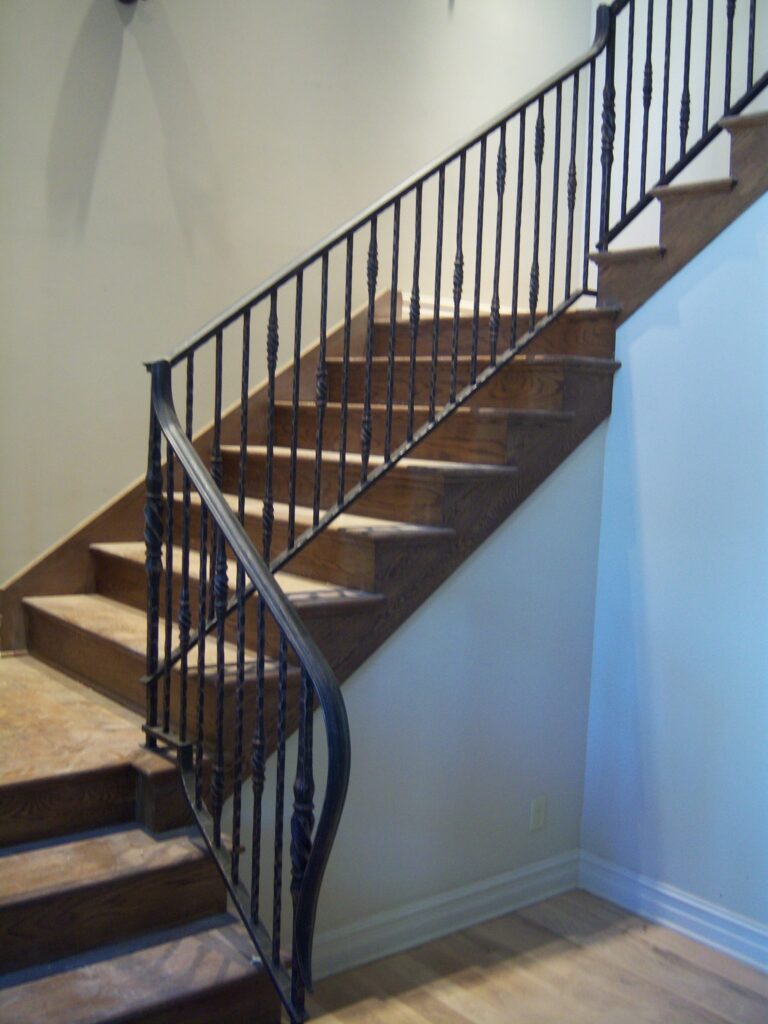
Iron Handrails for Homes: Where Safety Meets Style
A staircase without a proper handrail is an accident waiting to happen. But the right handrail does more than prevent falls — it defines the character of the space it occupies. In an entryway, on a porch, or along an interior staircase, a well-crafted handrail is one of the most visible architectural details in a home.
Iron handrails for homes sit at the intersection of those two goals. They provide the structural support and grip that safety requires, while offering a level of design flexibility and visual presence that most other materials can’t match. Whether the goal is a classic ornamental look or a clean contemporary line, iron can deliver it — and hold up for decades in the process.
At Berryhill Ornamental Iron, we’ve been designing and hand-crafting custom iron railings for homes throughout the Tulsa metro and Northeast Oklahoma for 27 years. Here’s everything you need to know about custom iron railing — from safety requirements to style options to what makes a quality installation.
Why Iron Is the Right Material for Home Handrails
Homeowners evaluating handrail materials typically consider wood, cable, glass, aluminum, and iron. Each has its place, but iron offers a combination of properties that’s difficult to replicate.
Structural strength
These installations carry real load. When someone grabs a handrail for support — particularly on a steep staircase, a wet exterior step, or in an emergency — the rail needs to hold without flex or give. Iron provides that rigidity in a way that wood degrades over time and aluminum can’t always match at comparable weights.
According to the International Building Code, residential handrails must be capable of withstanding a concentrated load of 200 pounds applied in any direction. A properly welded railing with correct post spacing meets and exceeds that requirement consistently over its service life
Longevity and weather resistance
Exterior handrails face constant exposure to sun, rain, temperature swings, and humidity. Railings finished with a quality powder coat resist corrosion, UV degradation, and physical wear far better than painted wood or untreated metal alternatives.
Powder coating bonds to the iron at the molecular level through an electrostatic process and heat curing. The result is a finish that’s harder and more adhesion-resistant than conventional paint — meaning it doesn’t chip, peel, or fade the way spray or brush-applied finishes do over time.
Design flexibility
Iron is shaped by the fabricator, not constrained by it. Unlike prefabricated aluminum or cable railing systems that come in fixed configurations, custom railings can be designed to any profile, any spindle pattern, and any finish. Scroll work, geometric patterns, transitional designs, and clean contemporary lines are all achievable in the same material.
That flexibility matters when the handrail needs to complement an existing architectural style — whether it’s a Victorian home with ornate ironwork, a craftsman with clean lines, or a modern build with minimal detailing.
Safety Standards for Residential Iron Handrails
Handrails aren’t just a design decision — they’re a code requirement in most residential applications. Understanding what’s required helps homeowners evaluate whether an existing handrail is adequate and what a new installation needs to include.
Height requirements
The International Residential Code requires handrails to be installed at a height of 34 to 38 inches measured vertically from the stair nosing. This range is designed to accommodate adults of varying heights while maintaining effective grip and support during stair use.
Graspability
Building codes specify graspability requirements for handrail profiles — the cross-sectional shape of the rail itself. A graspable handrail allows a person to wrap their fingers around it for a firm grip. Flat-top rails and decorative profiles that can’t be gripped may not meet code in applications where a graspable handrail is required.
According to the American Institute of Architects, graspability is one of the most commonly overlooked aspects of handrail compliance in residential remodels. A custom railing can be designed with a graspable top rail that satisfies code while still incorporating decorative spindles and design elements below.
Post spacing and structural integrity
Posts must be spaced and anchored to provide adequate lateral resistance along the full length of the rail. Proper anchoring into structural framing — not just into drywall or surface material — is essential for the rail to meet load requirements. This is one of the key areas where professional fabrication and installation matters most.
Iron Handrail Design Options for Homes
One of the most compelling aspects of custom ironwork is the range of design directions available within a single material. Here’s how homeowners typically approach the design decision:
Traditional and ornamental
Traditional railing designs feature scrollwork, twisted balusters, and decorative collars at intersections. These designs complement older homes, craftsman-style architecture, and any space where a more formal or period-appropriate aesthetic is the goal. Ornamental ironwork has been used in residential architecture for centuries precisely because it ages well and gains character over time.
Transitional
Transitional designs blend classical iron elements — forged balusters, simple scroll details — with cleaner lines and less ornamentation. They work in homes that mix traditional and contemporary elements and are one of the most requested styles for both interior staircases and exterior porch railings.
Contemporary and minimalist
Clean-line railings with flat bar balusters, square profiles, and minimal ornamentation suit modern and contemporary architecture. These designs prioritize geometry and proportion over decoration and pair well with open-concept interiors and new construction homes.
Custom and one-of-a-kind
Because every railing we build is hand-crafted at our facility in Broken Arrow, Oklahoma, every design detail is custom to the project. Homeowners can incorporate monograms, nature-inspired motifs, geometric patterns, or any other design element into the ironwork. No two installations are identical unless the homeowner wants them to be.
Interior vs. Exterior Railing: What’s Different
This material works equally well inside and outside the home, but the application affects design and finish considerations.
Interior railing
Interior staircases are the most common application for this style of railing in homes. The handrail defines the visual character of the staircase and, by extension, the entry or living space it connects. Interior installations are typically finished in black or dark bronze powder coat, though custom color matching is also available.
Interior installations are protected from weather, so finish longevity is primarily about wear resistance from handling rather than environmental exposure. A quality powder coat on an interior handrail will maintain its appearance indefinitely with minimal maintenance.
Exterior porch railing and steps
Exterior applications — front porch steps, deck perimeter railing, and entry handrails — require the same powder-coated finish but with more attention to anchoring and drainage design. Posts should be anchored into structural framing or set in concrete, and design details should avoid horizontal surfaces that collect standing water.
Oklahoma’s climate — with significant temperature swings, humidity, and exposure to driving rain — makes powder-coated iron a particularly good choice for exterior handrails compared to wood, which requires ongoing maintenance and degrades faster in these conditions.
What to Expect from a Custom Iron Handrail Installation
Homeowners who haven’t had custom ironwork installed before sometimes aren’t sure what the process looks like. Here’s a general overview:
- Consultation and quote — measurements are taken, design preferences are discussed, and a quote is provided based on the scope of the project
- Custom fabrication — the handrail is hand-crafted at the fabricator’s facility to the exact specifications of the project, including all design details and finish selection
- Powder coating — the finished ironwork is powder coated before installation for maximum finish quality and durability
- On-site installation — posts are anchored into structural framing or concrete, rails are set, and all connections are verified for structural integrity
- Final inspection — the installation is checked against code requirements and the homeowner’s specifications before project completion
The timeline from consultation to installation varies by project complexity and fabrication schedule, but most residential handrail projects move efficiently through the process.
Whether you’re replacing an aging handrail, adding railing to an exterior staircase, or designing a new interior staircase from scratch, we can build what you have in mind. Browse our iron railing projects for design inspiration, then contact us for a free quote.
Frequently Asked Questions
What is the best material for home handrails?
Iron is widely considered the strongest and most durable option for residential handrails. It meets building code load requirements, holds up well in both interior and exterior applications, and offers more design flexibility than wood or prefabricated aluminum systems. A powder-coated finish extends the service life significantly by protecting against corrosion and wear.
Do home iron railings require a lot of maintenance?
No. Powder-coated railing requires very little maintenance. Occasional cleaning with mild soap and water is sufficient for interior installations. Exterior handrails should be inspected annually for any chips or scratches in the finish that could expose bare metal, and touch-up paint can be applied as needed. A quality powder coat finish typically lasts many years before any refinishing is required.
How much does custom iron railing cost?
Cost varies based on the length of the run, the complexity of the design, and whether the application is interior or exterior. Simple straight handrails are less expensive than curved runs or ornamental designs with significant scroll or detail work. The best way to get an accurate number is to request a free quote based on the specific project.
Can iron railing be installed on existing staircases?
Yes. Existing staircases can be retrofitted with custom ironwork. The fabricator will measure the existing staircase geometry and custom-build the handrail to fit. Post anchoring is typically done into the existing stringers or floor framing, or into concrete for exterior applications.
Is iron railing compliant with building codes?
A properly designed and installed railing meets or exceeds residential building code requirements for load capacity, height, and graspability. Berryhill Ornamental Iron designs handrails to meet applicable code standards and installs them with correct post spacing and structural anchoring.
Author: Darin Berryhill